 |
 |
 |
 |
 |
 |
 |
 |
 |
 |
 |
 |
 |
 |
 |
 |
 |
 |

About 4,000 years ago, a prehistoric hunter-gatherer culture lived in the Grand Canyon, and remained in the region until maybe 1,000 B.C. The ancestral pueblo people arrived in the area about A.D. 500. Departing in 1150 A.D., they left behind remnants of some 2,000 village sites. In 1300, ancestors of the modern Hualapai and Havasupai migrated to the western areas of the Canyon...
I'm not teaching history here, but how do "they" know they left in 1150, and not 1149 or 1151? And by what standard was the calendar being applied? There's the Roman calendar, circa 7th century BC (but that was 10 months of 28 days), the Julian calendar from around the first century BC, or the Gregorian calendar (still in use today) from about the 16th century. Given that 1150 AD was on the Julian calendar period, what sort of adjustments were made for the current calendar mechanism? Of course, we're not going to address it here, but it's funny how historical types love referring to time that far back, without truly accounting for the variations in how the years were even counted. Bygones.
Anyway, there's a great big gouge in the earth in northern Arizona, which the government decided was a natural wonder, charges $20 per car admission (thus, the gouge is still going on today).
 |
 |
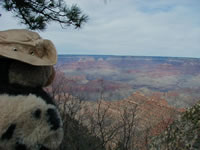 |
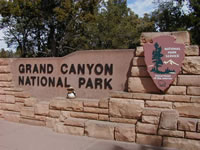
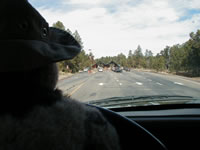
| While not historically correct, every nature wonder begins with a sign of some sort... | Despite the $20 per car (more for buses), there still a crowd on a Sunday afternoon to get in. | After enduring 25 MPG speed limits, though, we finally get to the big gorge's edge. |
 |
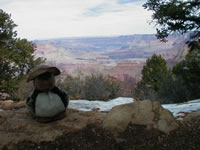 |
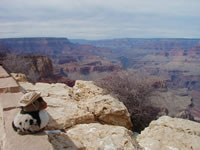 |
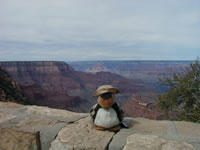
| Yes, I realize it looks like a fake backdrop, but I'm really there -- I got the weird looks to prove it. | It's only mid-March, and the altitude is lofty, the snow from the week before is still there. | Another one of those classic, on-the-edge and fake-looking shots... whatever... |
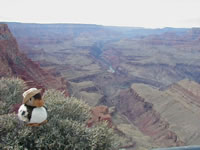 |
||
| By the boy sticking me on the shrub, admittedly, it looks like I'm hovering... but I have the thistle scars to prove otherwise. |